How Social Media Decides Which Hashtags Trend Together
Across finance, healthcare, e-commerce, and social platforms, the same core algorithmic principle applies: efficiently discovering meaningful co-occurrence patterns at scale. PCY enables this by reducing memory, computation, and noise—turning raw data into actionable insight.
AI/ML
1/12/20263 min read


When people think about social media trends, they often assume it’s just about volume.
“Whatever hashtag is used the most must be trending.”
In practice, that’s not how platforms work.
Trending isn’t only about how often a hashtag appears — it’s about which hashtags appear together. Co-occurrence reveals context, meaning, and emerging topic clusters.
When platforms come to me, the real question sounds like this:
“Which hashtags or topics consistently appear together often enough to represent a real trend?”
That’s a pattern-mining problem, not a counting problem.
How I model the problem
Before choosing any algorithm, I decide how social activity should be represented mathematically.
This modeling step is what turns chaotic social data into something computable.
Here’s how I frame it:
Transaction → One post or tweet
Each post captures a single expression of intent, interest, or conversation.Items → Hashtags or topics
Hashtags used together represent how users mentally group topics.Itemsets → Topic clusters
Repeated hashtag combinations indicate emerging or established trends.Support threshold → Trend significance filter
A hashtag pair must appear in enough posts to be considered a real trend rather than noise.
Once framed this way, trend detection becomes a co-occurrence problem:
If hashtags repeatedly appear together, they define a topic cluster.
Why PCY is needed at platform scale
After modeling the problem, the scale challenge becomes obvious.
Social platforms deal with:
Millions of posts per hour
Millions of unique hashtags
An explosive number of possible hashtag combinations
Counting all hashtag pairs directly is computationally impossible.
That’s why I use PCY.
PCY allows me to:
Narrow down candidate hashtag pairs efficiently
Eliminate unlikely combinations early
Focus computation on strong, repeated signals
What platforms get from this approach
By combining careful modeling with PCY, I produce:
Frequent hashtag pairs → trending topic clusters
Candidate pairs → emerging conversations worth watching
Final frequent pairs → signals used in ranking, discovery, and ads
💡 Platform value: better trend analysis, targeted advertising, and improved content discovery — without brute-force computation.
What social platforms are really asking
Under the hood, the core question is always:
“Which hashtags co-occur often enough to form a trend?”
With millions of posts and millions of hashtags, platforms need a way to:
Ignore one-off combinations
Detect repeated co-usage
Surface meaningful clusters in near-real time
That’s exactly what frequent itemset mining enables.
Step 1: Posts as transactions
I start by treating each post as a transaction.
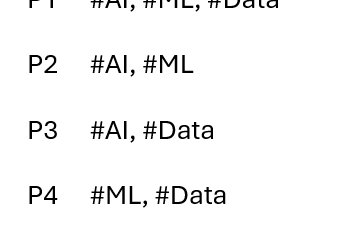
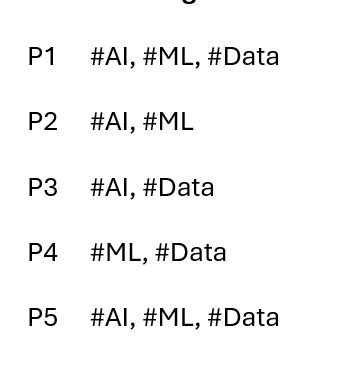
To make this efficient, I encode hashtags numerically:
1 = AI
2 = ML
3 = Data
4 = Crypto
I then define:
Minimum support = 3
This means a hashtag or hashtag pair must appear in at least 3 posts to be considered part of a trend.
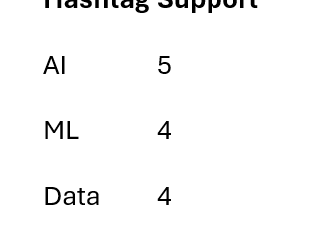
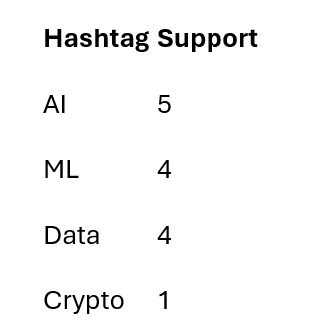
Step 2: Single-hashtag support (what I filter first)
Before looking at hashtag combinations, I identify which individual hashtags are frequent enough to matter.
Only hashtags meeting the support threshold survive.
Frequent hashtags:
{AI, ML, Data}
Crypto is dropped early — not because it lacks importance, but because it doesn’t appear often enough in this dataset to define a recurring topic cluster.
This early pruning removes noise and keeps the analysis focused.
Step 3: PCY hashing (how I control combinatorial growth)
Now I apply PCY’s first pass.
Instead of tracking all hashtag pairs explicitly, I hash pairs into buckets and count bucket frequency.
Only promising hashtag pairs survive the hash filter.
Why PCY matters here
Instead of tracking all hashtag combinations, I:
Hash pairs
Keep only frequent buckets
Count only strong, repeated signals
Hash collisions are acceptable — they simply make the filter conservative.
This step ensures the system scales even as hashtag volume explodes.
Step 4: Candidate hashtag pairs
Using the PCY filters, I construct candidate pairs (C₂).
Candidate pairs:
AI–ML
AI–Data
ML–Data
Only these pairs satisfy:
Both hashtags are individually frequent
Their hash buckets are frequent
Everything else is ignored.
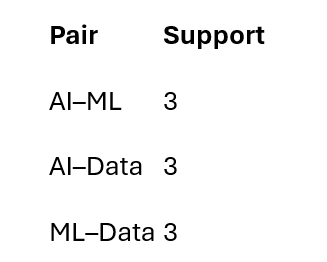
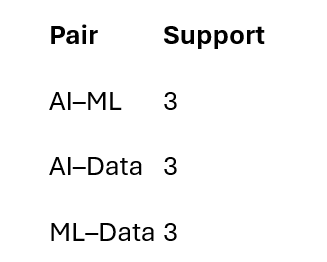
Step 5: Final counting (what defines a trend)
Now I perform exact counting — but only on candidate pairs.
These pairs form the final frequent hashtag pairs.
They represent topic clusters that consistently co-occur across posts, not one-off viral noise.
Platform impact (where trends are born)
These frequent pairs:
Define topic clusters
Influence trending sections
Power content recommendations
Drive targeted advertising
Because the patterns are grounded in repeated co-occurrence, they’re far more stable and meaningful than raw hashtag counts.
PCY doesn’t decide what’s trendy by popularity alone.
By modeling posts as transactions and hashtags as co-occurring items, I help platforms detect trends based on how users actually connect topics.
PCY makes that scalable.